
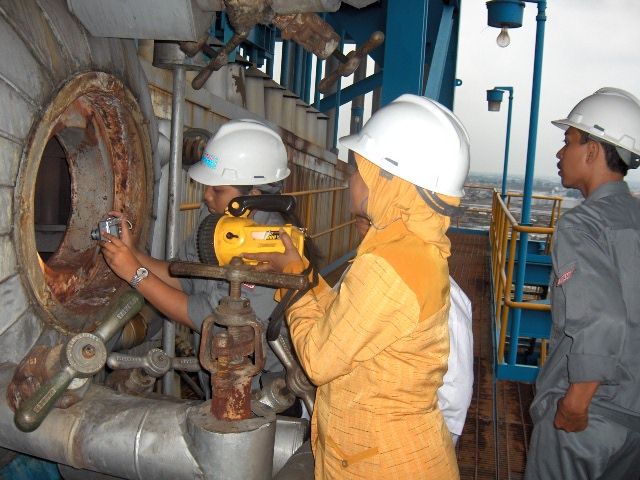
Tube Cleaning is a term for the cleaning activity of tubes or devices to clean and maintain the tubes were fouled.
In the food industry, pharmaceutical industry, as well as in medical technology greatly required in order to a tube free from foreign objects, deposits or obstructions. These things can happen as a result of changes in product or after tube installation is done. Another problem that could arise if it is not done cleaning the tubes is corrosion, because the deposits can cause tube failure.
Cleaning the tube can not be done the same way on each tubes. Cleaning is dependent on the use, size and material of the tube. Different material different methods.
In the medical sector, the technical term is ” lost tubes ” or disposable tube. As with other medical equipment, example; syringes, infusion, and other medical equipment, tubes also use disposable implement immediately discarded. The reason for this is mainly that eliminate the risk of infection to the next user. In addition, the fact that the cost of cleaning tools are very expensive beyond the proportion of available cost. Therefore, the single use is considered appropriate. In the health sector, the commonly used tube is a tube with a diameter of 20mm, while outside the sector, such as pharmaceutical and food sectors, the width of the diameter of the tube can be more than 20mm. But for the same reasons, a single use can also be applied in other industries besides health sector.
For other uses, e.g as heat transfer, etc. , the tube may also need to be replaced occasionally. But this can be done with less frequently or in the long run when the tube showed serious flaws ( e.g ; corrosion , etc. ) .
Tubes can also be cleaned using chemicals, if this is done then the so-called ” Chemical Cleaning Tube ” . Chemical Cleaning Tube can be defined as the use of chemicals fluids to remove or cleaning the blocking layer inside the tube. For example, using acetic acid or the acid of lemon can clean deliming of coffee maker. Again depending on the field of application and the tube material, because it could be different areas and materials would require a special cleaning fluid which is also different. In a once of chemicals cleaning tube, conducted several stages, they are; Chemical activation, Cleaning, and Rinsing.
This method causes some problems such as unwanted standstill period, a number of cleaning fluid is likely to cause major disposal problems. In the food industry, the possibility of problem appears is toxicity of cleaning fluid. These things can be overcome only if the cleaners obey the instructions and precise control of tolerances acceptable residue. And this in turn requires that the detection process is quite expensive. However, the plus is Chemical Cleaning Tube can be used in all sizes of tube diameters.
The process is not less interesting is the use of tube cleaning robot, a small brush or a particular pressurized water spray. These processes can also be called Off – line Process. Diameter which can be reached by using this model is 300 mm clearance to 2 meters. Cleaning the tube by heating can also be included in the process of off-line, but this method is used for the sterilization of certain and usually used for food industry and pharmaceutical industry. With the off-line process, then it is definitely mention of On-line Process. On-line Process using a rubber sponge to clean the tubes. Diameter tube that can be reached is the range in 55mm.
Cleaning the tubes with certain types can be done with a specially methods such as the use of vibration generators, partly by means of a piezoelectric crystal, using a magnetic field , nanotechnical and forth to avoid the deposit barrier and layers in tubes.
Recent Comments